

Press Release
Hyundai E&C Completes Development and Demonstration of Rock Excavation Equipment for Spent Nuclear Fuel Disposal Facility
■ Develops Korea’s First Dedicated Deposition Hole Excavation Equipment; Validates Performance and Constructability Through Actual Rock Excavation
■ Advances Core Repository Construction Technologies, from Deposition Hole Excavation to Rock Assessment and Construction Material Development
■ Only Construction Company Participating in Government-Funded R&D; Strengthens Full-Lifecycle Capabilities Across Nuclear Power Plant Construction, Decommissioning and Disposal
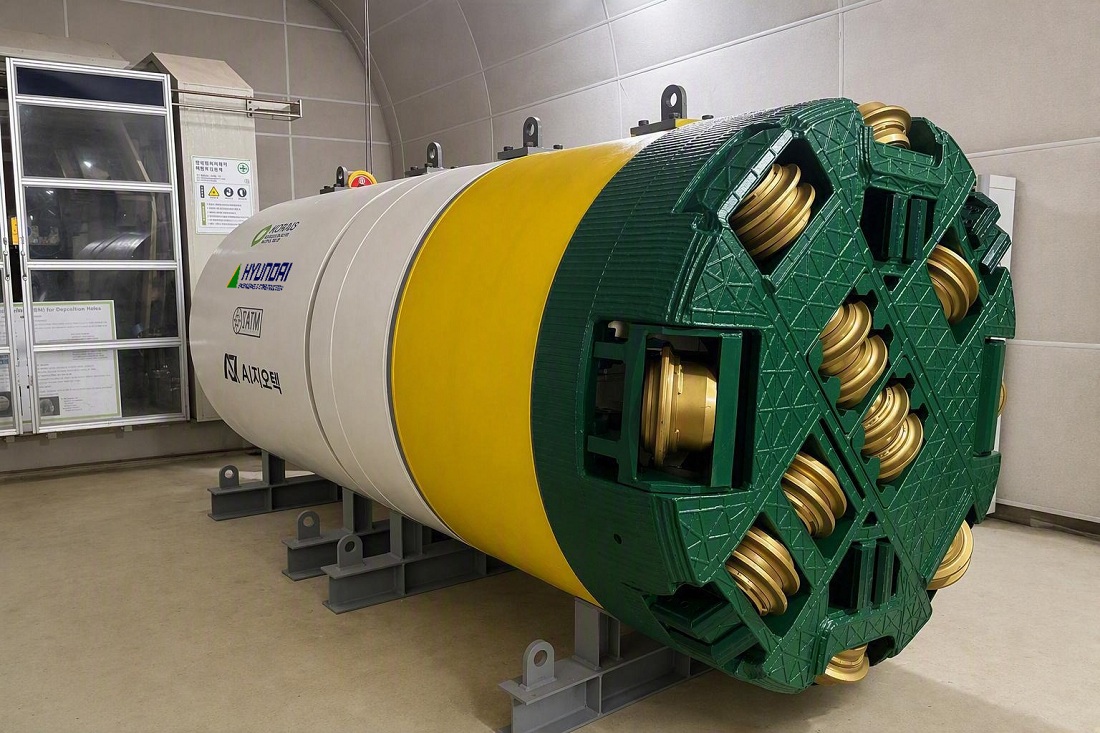
Hyundai E&C's Dedicated Deposition Hole Excavation Equipment for Spent Nuclear Fuel Disposal
Hyundai E&C is accelerating efforts to secure the core technologies required to build high-level radioactive waste disposal facilities.
Hyundai E&C announced on Friday, the 2nd, that, following its development of excavation equipment for spent nuclear fuel deposition holes, the first of its kind among Korean builders, it has successfully completed excavation at the scale of an actual deposition hole in the bedrock at its research demonstration site.
Deposition Hole: A hole excavated in underground bedrock for the permanent emplacement of disposal canisters containing spent nuclear fuel, ensuring the fuel remains safely isolated over the long term.
The achievement was made as part of a government-funded R&D project on spent nuclear fuel management led by the Korea Radioactive Waste Agency (KORAD). Hyundai E&C is the only construction company participating in the project. Through the HMG Construction Technology Research Institute, the integrated R&D organization of Hyundai E&C and Hyundai Engineering, the company is developing the core technologies needed to construct disposal facilities, including excavation equipment and methods as well as rock monitoring.
Spent nuclear fuel is nuclear fuel that has been removed from a nuclear power plant after being used as fuel. Because it emits high levels of radiation and heat over a long period, it is crucial to develop technologies for its safe management and disposal. Accordingly, in disposal facilities constructed deep within underground bedrock, the construction quality of the deposition holes, where containers holding spent nuclear fuel are ultimately placed, determines the long-term safety of the facility. In particular, if cracks or damage occur in the surrounding bedrock during the deposition hole excavation process, pathways for groundwater flow may form. Therefore, precision construction techniques that minimize the area of excavation-induced damage are required.
The dedicated deposition hole excavation equipment developed by Hyundai E&C measures 1.75 meters in diameter and 5.7 meters in length. It is designed to meet the deposition hole specifications and construction conditions required by the Korea Advanced Disposal System (KORADIS). In particular, the equipment features a “foldable cutterhead”, which addresses the need to excavate multiple deposition holes repeatedly at a disposal facility. Once excavation is complete, the cutterhead is folded, so the equipment can be safely retrieved and reused.
Korea Advanced Disposal System (KORADIS): A disposal system for spent nuclear fuel, developed to suit Korea’s geological environment and technical conditions.
Hyundai E&C verified the equipment's performance and constructability by carrying out full-scale deposition hole excavation in rock in an underground research tunnel. During the demonstration, AI analyzed excavation data in real time to assess ground conditions, so excavation could be optimized based on the analysis results and equipment performance. After excavation, LiDAR-based digital mapping was used to verify construction quality and assess the suitability of the deposition hole, enhancing the reliability of the results.
Hyundai E&C is expanding its research beyond excavation technologies to include construction materials and rock engineering, to ensure the long-term safety of disposal facilities. The company is developing concrete and grout that secure the long-term performance of engineered barriers and control groundwater inflow. It is also advancing a rock classification system tailored to Korea's geological characteristics, along with digital rock assessment and monitoring technologies. By doing so, Hyundai E&C aims to secure the full range of core technologies required for disposal facility construction.
An official from the HMG Construction Technology Research Institute said, "This achievement is particularly significant because Hyundai E&C has become the first Korean builder to develop dedicated deposition hole excavation equipment and verify its performance and constructability through actual rock excavation." The official added, "By strengthening our core capabilities across the entire nuclear lifecycle, from nuclear power plant construction and decommissioning to spent nuclear fuel disposal, we will continue to solidify Hyundai E&C's position as a game changer in the global nuclear industry."
