

Latest News
- Hyundai E&C Brings Startups Together to Showcase Innovative Construction Technologies
- Hyundai E&C Holds Completion Ceremony for 12th Cohort of "Dream Mentoring Volunteers” Program
- Hyundai E&C Supports “Sustainable Growth” at Its Partner Companies
- Hyundai E&C and Hyundai Steel Secure Technology for High-Performance Composite Beam Technology with Enhanced Structural Safety and Quality
- Hyundai E&C’s Century-Long Ambitions Come to Life in a 45m Mega Graphic
[Nuclear Log] Hyundai E&C Redraws the Global Nuclear Power Map
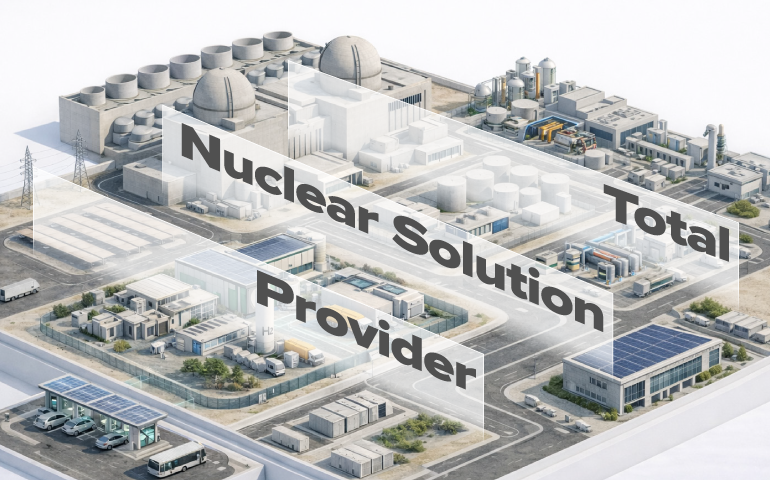
The world is once again turning its attention to nuclear power. This is due to the global challenge of achieving carbon neutrality and the explosive increase in electricity demand driven by the expansion of the AI industry. Currently, 415 nuclear power reactors are in operation across 32 countries worldwide, with 72 more under construction. In other words, the so-called “nuclear renaissance” is fast becoming a reality. Against this backdrop, Hyundai E&C is expanding its footprint in the global nuclear market, leveraging the deep technological expertise it has cultivated over the past 50 years. The company adopts a comprehensive view of the entire energy infrastructure lifecycle, covering not only nuclear plant construction but also life extension, decommissioning, and next-generation reactors. Beyond Korea, from the deserts of the Middle East to Europe, where the energy transition is accelerating, and to the United States, where power grid expansion is in full swing in the age of AI, Hyundai E&C is working with partners around the world to prepare for a more stable and sustainable future.
A 55-Year Trajectory, 24 Milestones
Hyundai E&C was there at the very site where construction began in 1971 on Kori Unit 1, the Republic of Korea’s first nuclear power plant. In the 55 years since, Hyundai E&C’s nuclear power plant construction record has never been interrupted even once. From the standardized nuclear power plants(NPPs) of the 1990s (Hanbit), a symbol of Korea’s technological self-reliance in nuclear power, to today’s latest export-ready models (Saeul and Shin Hanul), Hyundai E&C has maintained its presence at project sites, serving as the lead contractor for 24 of the 36 Korean large-scale nuclear power units built in Korea and abroad. In the process, it also accumulated experience as the first Korean construction company to build both pressurized water reactors and pressurized heavy water reactors. In the early 2010s, the company demonstrated its capabilities by simultaneously constructing as many as 10 nuclear power units (including Barakah in the UAE and Shin Hanul, Saeul, and Shin Kori in Korea). By fully delivering on the nuclear industry’s core competitive principle of “On Time Within Budget,” Hyundai E&C proved its reliability to the world.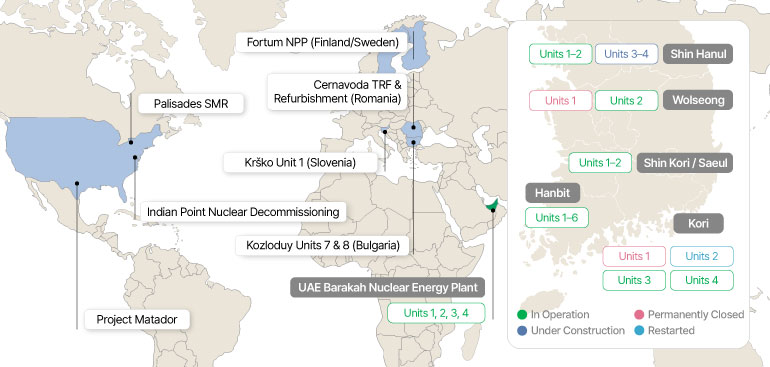
Part 1. Large Nuclear Power Plant
Becoming the Benchmark for Global Large-Scale NPPs
Nuclear Competitiveness Demonstrated by Homegrown Technology
Shin Hanul Unit 3&4
The main equipment contract for Shin Hanul Units 3 and 4 is a large-scale project to build two 1,400MW-class nuclear power units in Uljin County, North Gyeongsang Province, with the scheduled construction period alone extending to approximately 115 months. As it was the first new domestic NPP order placed in eight years, competition to win the contract was fiercer than ever. With the “comprehensive evaluation-based bidding system”, which rigorously assesses not only price competitiveness but also technological expertise and execution capacity, being applied for the first time, Hyundai E&C excelled in the evaluation process, securing the contract. Following its work on Shin Hanul Units 1 and 2, Hyundai E&C is consecutively constructing Units 3 and 4 of the same reactor design, APR1400. This has not only maximized project synergies in terms of construction efficiency and quality control, but also served as another opportunity to demonstrate, both at home and abroad, the overwhelming technological competitiveness of the Korean-designed nuclear reactor, the APR1400.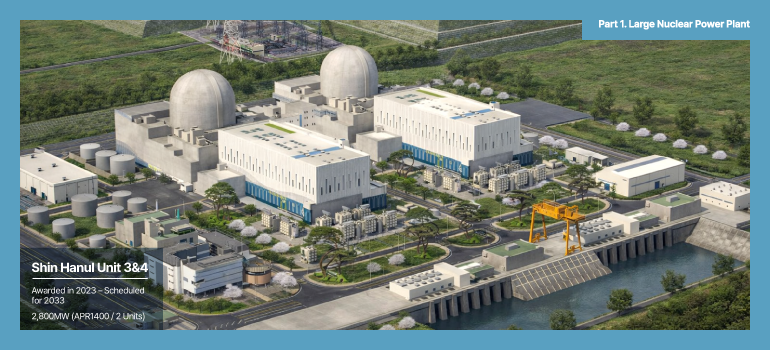
Barakah Establishes the Benchmark for Predictable NPPs
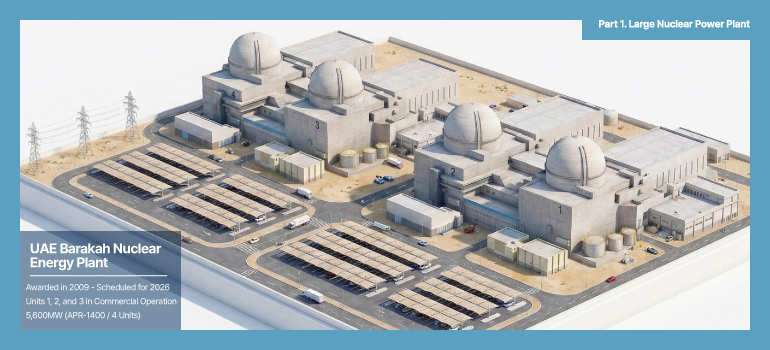
UAE Barakah Nuclear Energy Plant
Awarded in 2009, this project, worth about USD 20 billion, was a historic first overseas venture that elevated the Republic of Korea into the ranks of the world’s sixth NPP exporter. It was a mega-project involving the simultaneous construction of four Korean-designed nuclear power units (totaling 5,600MW) on a site roughly four times the size of Yeouido. Even while building four large-scale nuclear power units at the same time, Hyundai E&C flawlessly delivered what is considered difficult to achieve in the global nuclear market: “On Time, Within Budget” construction, thereby establishing itself as a symbol of global NPP construction. Having already progressed through Units 1, 2, and 3, which are now in commercial operation, the Barakah Nuclear Energy Plant, with overall completion scheduled for this year, is already operating as critical national infrastructure.
Hyundai E&C Secures a Foothold in Eastern Europe’s NPP Market
Kozloduy Units 7 & 8 (Bulgaria)/ Krško Unit 1 (Slovenia) New Build
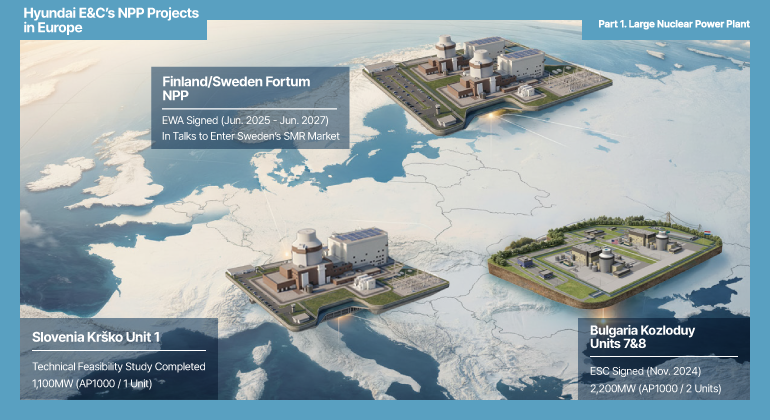
Europe is the next destination for Hyundai E&C, following the company’s demonstration of flawless construction capability at the UAE Barakah Nuclear Energy Plant. The first tangible outcome came in Bulgaria in November 2024. Hyundai E&C achieved a major milestone by forming a consortium with Westinghouse of the United States and signing an Engineering Services Contract (ESC) for Kozloduy Units 7 & 8. By independently passing the highly demanding pre-qualification (PQ) process, the company once again proved its unrivaled technological competitiveness. In particular, this project is significant in that it marks Europe’s first adoption of the AP1000 reactor design and positions Hyundai E&C as a key partner at a turning point in Eastern Europe’s energy security.
The successful signal flare launched in Bulgaria is now extending to neighboring Slovenia. A new NPP with a capacity of approximately 1,100MW is currently being planned at the Krško NPP site in Slovenia. Hyundai E&C has successfully carried out the technical feasibility study for this project, thereby gaining the upper hand ahead of the future EPC contract award.
From Eastern Europe to the Nordic Region
Finland/Sweden Fortum Nuclear Power Project
The momentum of nuclear power projects that began in Eastern Europe is now expanding into Nordic countries. Last year, Hyundai E&C signed an Early Work Agreement (EWA) with Fortum, a leading Nordic energy company, for the introduction of new NPPs in Finland and Sweden. Although this represents preliminary work ahead of the main EPC contract, it carries particular significance as a core partnership premised on future participation in the project. In particular, in the Nordic market, where countries are moving quickly to secure stable power sources while pursuing the national net-zero initiatives and energy independence, Hyundai E&C has been selected as the preferred partner and has taken an early lead in establishing its business foothold.
Beyond Nuclear Construction, Toward an Integrated Energy Platform for the AI Era
U.S.A Project Matador
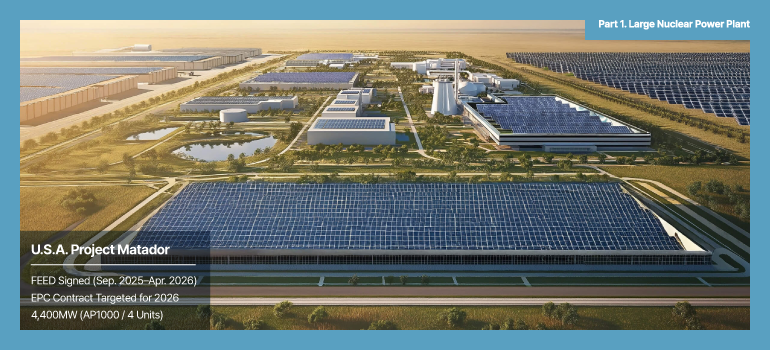
In 2025, Hyundai E&C made new history by becoming the first Korean company to enter the U.S. large-scale nuclear power market. The stage for this milestone is “Project Matador”, being developed in the Amarillo area of Texas in cooperation with U.S. energy developer Fermi America. The project, which involves building a large-scale AI data center and integrated energy complex on a site more than eight times the size of Yeouido, is regarded as the largest power generation project in U.S. history. The complex is planned to produce a massive 17GW of electricity through a private grid centered on nuclear power and organically integrated with solar power and gas-fired combined cycle generation. Hyundai E&C is currently carrying out the Front-End Engineering Design (FEED) for four large-scale nuclear power units and is strengthening its partnership with the aim of signing the main EPC contract this year.
Part 2. Next-Generation Nuclear Tech
Becoming a First Mover in the Next-Generation NPP Market
Aging Nuclear Plants Reborn, with Power Switched Back On Through SMRs
U.S.A. Palisades SMR
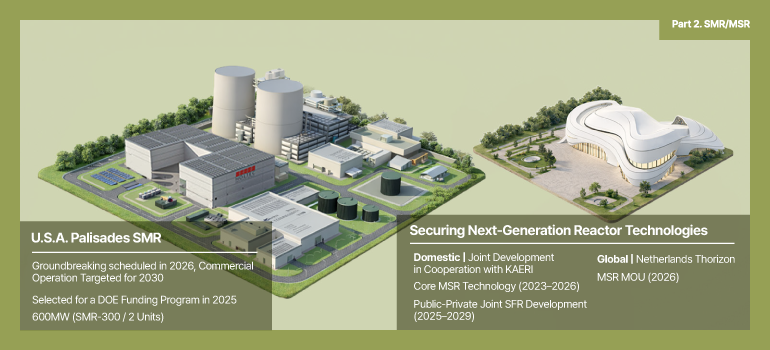
The site of the Palisades NPP in Michigan, where operations were suspended in 2022 due to economic reasons, is being reborn as a next-generation energy hub. Hyundai E&C, together with U.S. nuclear specialist Holtec International, is pursuing a project to build two 300MW-class small modular reactors (SMR-300) at the site. This project is the “first-of-a-kind (FOAK)” deployment of the SMR-300 model. As the first case to validate the commercial viability of SMRs, which had previously remained largely at the conceptual stage, it is drawing close attention from the global nuclear industry.
Hyundai E&C is accelerating the project with the goal of completing construction of Unit 1 by 2030. The company further strengthened the project’s foundation late last year by securing approximately USD 400 million in grant support from the U.S. Department of Energy (DOE) and has entered the full-fledged commercialization process by completing its application for a Limited Work Authorization (LWA).
Next-Generation Reactors, Game Changer of the Future Energy Landscape
4th Generation Reactors (MSR and SFR)
At a time when the global energy market is widely expected to enter a phase of full-fledged growth centered on next-generation reactors, Hyundai E&C is focusing on building the future competitiveness needed to respond. At the core of this effort, the company is also accelerating the securing of “4th generation reactor (MSR·SFR)*” technologies, which offer dramatically improved safety, economics, and proliferation resistance compared with existing reactor designs. To this end, Hyundai E&C is working with the Korea Atomic Energy Research Institute (KAERI), the nation’s leading comprehensive nuclear R&D institution, on a public-private joint development of SFR (2025–2029) and on the development of core MSR technologies (2023–2026), thereby strengthening competitiveness in the next-generation nuclear power industry. Furthermore, the company recently signed an MSR technology cooperation partnership with Thorizon, a Dutch nuclear innovation company. It is a strategic move by Hyundai E&C to pursue both technological internalization and early leadership in the global market at the same time.
*MSR (Molten Salt Reactor): A next-generation reactor that uses liquid molten salt, rather than solid nuclear fuel rods, as both the fuel and the coolant. Because it operates at low pressure, it carries little risk of explosion, and in an emergency the fuel solidifies on its own, helping prevent the release of radioactive materials and ensuring high level of safety.
*SFR (Sodium-cooled Fast Reactor): A reactor that uses liquid sodium, instead of water, as a coolant. Because it can recycle spent nuclear fuel for reuse as fuel, it can dramatically reduce both the volume and toxicity of radioactive waste and is therefore often referred to as a “nuclear waste burner,” a resource-circulating reactor.
Part 3. Nuclear Life Cycle Solution
Leading the KRW 500 Trillion Blue Ocean Market for Decommissioning and Life Extension
From Construction to Decommissioning, Expanding Across the Entire NPP Life Cycle
U.S.A. Indian Point Nuclear Decommissioning Project
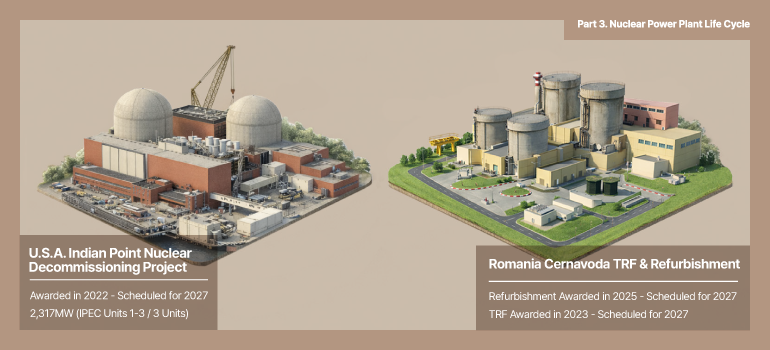
The global nuclear decommissioning market is a vast blue ocean, projected to grow to approximately KRW 500 trillion by 2050. Hyundai E&C is laying the groundwork for decommissioning technology through projects such as the steam generator replacement work for Kori Unit 1. In 2022, it also became the first and only Korean builder to successfully enter the U.S. nuclear decommissioning market.
Hyundai E&C is currently participating, together with Holtec, in the Indian Point Nuclear Decommissioning (IPEC) Project in New York State, US. The company is directly executing the core high-complexity processes throughout the entire decommissioning cycle - including reactor structure segmentation, dismantling of contaminated systems and components, and spent nuclear fuel transfer - thereby building a solid track record of globally competitive technical expertise. Hyundai E&C plans to actively leverage the advanced know-how secured in the United States in domestic decommissioning projects for aging nuclear power plants, including Kori Unit 1, in order to secure leadership in both domestic and overseas markets.
From Operation to Life Extension, Expanding the Value of NPP
Romania Cernavoda TRF & Refurbishment
Decommissioning is not the only solution simply because an NPP has reached the end of its original design life. For nuclear power plants whose safety has been verified, life extension through equipment upgrades can be a more efficient option from the standpoint of energy security and carbon reduction.
In 2023, Hyundai E&C participated in the construction project for the Cernavodă Tritium Removal Facility (TRF)* in Romania, successfully entering the Eastern European market for the first time in the nuclear sector. This project involves building a key safety facility that captures and stores tritium generated during the operation of heavy water reactors, and it plays an essential role in securing the long-term safety and stability of NPPs. Furthermore, Hyundai E&C is also participating in the refurbishment project for Cernavodă Unit 1 at the same site. This is a large-scale remodeling project that replaces aging equipment and reconstructs major systems, enabling approximately 30 years of continued operation.
Through the Cernavodă project, Hyundai E&C is presenting an integrated solution that links plant refurbishment with the construction of safety facilities, thereby solidifying its capabilities in “One Total Management” that go beyond new build projects to maximize the utility of existing assets.
*TRF (Tritium Removal Facility): A facility that separates and extracts tritium, a radioactive substance. It is a critical safety infrastructure that minimizes radioactive waste, and, through the extraction of tritium that can be utilized as a fusion fuel and as a special industrial material, it offers resource-circulation value.
Join Hyundai E&C newsletter.
Hyundai E&C Newsletter
Meet the various stories from Hyundai E&C Newsletter every month.
Subscribe to Hyundai E&C newsletter and get the latest news via e-mail.
- Name
-
-
@
- Part
-
- country
-
Privacy Policy
We may collect the personal information for the following purposes.
- Information
- Name, E-mail, and Part
- Subject
- Apply and Discribe for the Newsletter, Deliver Newsletter
- Period
- Your personal information will deleted in 5days of work day.
- Name
-
-
@

Registration Number 101-81-16293, 03058 Hyundai Bldg., 75, Yulgok-ro, Jongno-gu, Seoul
© HYUNDAI E&C. ALL RIGHTS RESERVED.